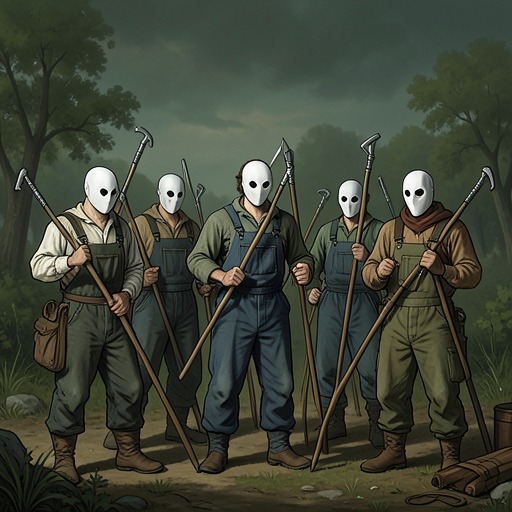
Homemade ritual weapons
The Cabin at the End of the WorldHomemade ritual weapons are three improvised wooden staffs used during the siege at the cabin. Their significance lies not only in their capacity for violence but in how they are repeatedly arranged, cleaned, taken up, and left behind as the confrontation changes. They accompany the visitors’ renewed demand that the family make a choice, yet their possession is never stable: a weapon associated with the attackers’ earlier violence becomes a means of resistance, and Andrew later takes up one of the staffs himself.
Inventory and Material Form
The weapons are assembled from wooden staffs and adapted with blades. One is described as dual-ended and the largest of the three; its metal ends include a sledgehammer end. Another, Adriane’s staff, is tipped with flower-shaped shovel and trowel blades. The account identifies the collection as three homemade weapons, but does not provide a complete description of every staff’s construction. Their rough, practical appearance contrasts with the deliberate confidence with which some of the visitors wield them.
The dual-ended weapon carries a particularly charged history: it had been used in the earlier violence against Redmond. Later, it is propped beside Leonard and Wen on the couch, a conspicuous object within the room even while Leonard speaks calmly to the family. Its placement beside them makes the threat present without requiring Leonard to brandish it. At another point he holds the same staff behind his back, an attempted concealment that Andrew immediately recognizes as ineffective.
Cleaning and the Cabin’s Domestic Space
After the violence, Adriane stacks all three weapons beside the woodburning stove and spends more than an hour cleaning them with warm water, a little dishwashing detergent, and hand towels. The painstaking work places the staffs among the afternoon’s other efforts to restore order: Sabrina scrubs the bloodstained floor, and Adriane returns the kitchen table to its usual place. The weapons are not discarded or put away. They remain in the shared room, cleaned and ready to be handled again.
Adriane also uses books to steady the table’s bent, loose leg. Eric’s book about a missing child proves the wrong size; Andrew’s book of critical essays works better. This small repair sits beside the cleaning of the weapons, linking ordinary maintenance to the objects that have made the cabin unsafe. The room is being made usable again, but its repaired arrangements do not undo what happened. The staffs remain visible among the furniture and domestic tasks, their presence interrupting any simple return to normal life.
The Renewed Ultimatum and Changing Possession
When Leonard presents the family with the same choice again, the weapons mark the change from a domestic pause back to confrontation. Leonard and Sabrina gather the staffs they had wielded the previous day, holding them with the confidence of people who have already used them successfully. Adriane, by contrast, is empty-handed. Her cleaned weapon leans against the stove like a rustic decoration, conspicuously out of reach and described as impractical. The contrast is material as well as strategic: the weapon exists in the room, but Adriane is not carrying it when she joins the renewed presentation of the ultimatum.
During the later struggle, Eric has taken up Adriane’s bladed staff. His leg remains caught in rope attached to a fallen chair, limiting his movement as he swings the weapon to keep Adriane at bay. Leonard stands near the couch with the dark television behind him and uses conciliatory language, while keeping the dual-ended staff hidden behind his back. The weapons therefore do more than divide the room into armed and unarmed sides: their use and concealment reveal different forms of control. Eric’s staff is an exhausted defense; Leonard’s concealed weapon lets him appear to invite calm while retaining an advantage.
Andrew enters while the others are focused on Eric. Afterward, he takes the dual-ended staff from beside the couch and advances toward Leonard, holding its sledgehammer end. Eric tries to stop him. Andrew lowers the weapon, then raises it again as he speaks of having already killed Adriane and intending to kill Leonard too. The weapon has crossed the boundary between the visitors’ equipment and the family’s attempted self-defense, but possession does not settle what should be done with it. Andrew’s hesitation makes that distinction visible: he can take up the instrument without being compelled to carry out the threat he voices.
Function in the Siege
The staffs recur as the ultimatum recurs. Their collection, cleaning, and renewed use give the repeated confrontation a physical continuity: the weapons survive each shift in the room’s mood, from the stunned aftermath of violence to the visitors’ organized return and then to the family’s resistance. Their repeated presence makes the so-called choice difficult to separate from force. The visitors may present the demand in measured terms, but they assemble with weapons in hand, while Leonard’s hidden staff undermines his performance of restraint.
At the same time, the weapons do not have a single, fixed owner or meaning. Adriane’s staff is first part of the attackers’ arsenal, then an object she cleans and leaves beside the stove, and finally the implement Eric uses against her advance. The largest staff shifts from a weapon associated with the visitors’ violence, to a prop beside Leonard, to an object Andrew takes up at a moment of grief and anger. These changes keep the staffs from functioning as mere background decoration: the hands that hold them, the distance at which they are kept, and whether they are displayed or concealed all register changing power and intention inside the cabin.